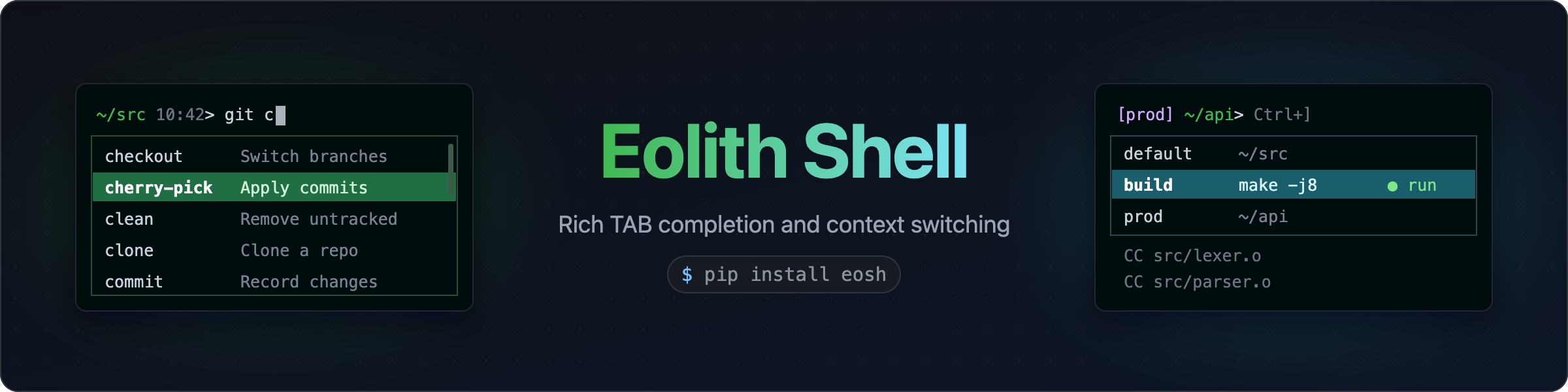
Eolith Shell
Eolith Shell (eosh) is a lightweight but powerful terminal shell environment with rich tab completion and context switching.


Features
- Rich tab completion — per-argument completers with descriptions, inline picker UI
- Flag completion — TAB on
-lists every flag with its description; a flag that takes a value goes straight on to completing that value - Context switching — named environments with variables and working directories, switched by name or live with
Ctrl+] - PTY process multiplexing — run processes in contexts and switch between them without killing them
- Pipelines and redirections —
|,>,>>,<,2>,2>&1,;,&&,||, globs (*,?,**), and\-line-continuation - Pipeline decorators — wrap any pipeline with
@watch,@time,@retryor@quiet; authoring your own is a few lines of Python - Custom commands — define Python functions as shell commands with full completion support
- Python-backed variables —
var aws_region=us-east-1can drive multipleos.environkeys via aVarsubclass;$NAMEexpansion is symmetric - Completion recipes — opt-in TAB completion for
git,make,ssh,aws, and more - Protocol fallbacks — automatic completion for cobra-based tools (
docker,kubectl,helm,gh, …) and argcomplete-based Python CLIs (pipx,conda,pre-commit,tox, …) — no recipe needed - System command fallback — anything not a registered command runs through the system shell
- Cross-platform — interactive shell, completion, pipelines, redirects, contexts, and history all work on POSIX and Windows; PTY-backed multiplexing of running native processes is POSIX-only
- History — persistent history with up/down navigation,
Ctrl+Rsearch, and past command lines offered as multi-argument TAB candidates, scoped to the context and directory you’re in - Desktop notifications — an OS notification when a command that took more than 10 seconds finishes, including ones running in a backgrounded context; native backends only, no extra dependencies
Installation
Requires Python 3.12+. The core has no dependencies beyond the standard library.
pip install eosh               # or: pipx install eosh / uv tool install eosh
pip install "eosh[awsut]"      # + the `awsut` add-on (boto3, pexpect)
uv tool install "eosh[awsut]"  # same, as an isolated uv tool
On first launch eosh writes a starter ~/.eosh/config.py that enables
every built-in recipe and bundled add-on. Without the [awsut] extra,
awsut is skipped and everything else loads normally; running awsut then
says which module is missing and which extra provides it.
uv tool and pipx install eosh into its own virtualenv, so a
pip install boto3 in another shell does not reach it — add packages with
uv tool install eosh --with <pkg> or pipx inject eosh <pkg>. With
uv tool, --with replaces the previous list, so repeat any earlier
entries (uv tool list --show-with shows them).
From source
git clone https://github.com/crftwr/eosh
cd eosh
make install      # .venv/ with `pip install -e ".[dev]"`
make test
make run
Usage
eosh
Built-in Commands
| Command | Description |
|---|---|
cd [path] |
Change directory (default: home) |
help [command] |
Show help for a command or list all commands |
context |
Manage contexts (see below) |
var [NAME[=VALUE] ...] |
List variables, print one (var NAME), set (var NAME=VALUE), or unset (var NAME=) |
alias [NAME[=EXPANSION] ...] |
List aliases, show one, or define a shorthand for a command |
unalias NAME [NAME ...] |
Remove aliases |
source-bash [FILE [ARG ...]] |
Run a bash script (or a pasted block) and import its variables and cwd |
reload |
Reload ~/.eosh/config.py without restarting |
exit |
Exit the shell |
Any command not listed above is passed through to the system shell (e.g., ls, git, grep).
Aliases
An alias replaces the first word of a command line. Quote the expansion when it contains spaces:
eosh> alias hp='awsut sagemaker hyperpod'
eosh> hp list                  # runs: awsut sagemaker hyperpod list
eosh> alias                    # list all aliases
eosh> unalias hp
Importing Variables from Bash
source-bash runs a script in a real bash — so export, $(…), loops, heredocs and conditionals all work — and imports the environment and working directory it leaves behind, the way bash’s own source would:
eosh> source-bash              # paste `export KEY=VALUE` lines, end with a blank line or Ctrl+D
eosh> source-bash setup.sh s3  # source a file with arguments
eosh> source-bash -c 'export A=$(date +%s)'
--no-cd keeps the current directory and -q suppresses the summary of imported variable names. Shell functions, aliases and shell options can’t be imported.
Contexts
Contexts let you define named environments with variables that are exported to os.environ and a remembered working directory.
eosh> context new prod
Created context 'prod'
[prod] eosh> var ACCOUNT=123456 REGION=us-east-1
[prod] eosh> context new staging
Created context 'staging'
[staging] eosh> var ACCOUNT=789012 REGION=us-west-2
[staging] eosh> context list
  * staging {'ACCOUNT': '789012', 'REGION': 'us-west-2'}
    prod {'ACCOUNT': '123456', 'REGION': 'us-east-1'}
    default
[staging] eosh> context close
Closed 'staging', now in 'prod'
Context subcommands:
| Subcommand | Description |
|---|---|
context new <name> |
Create a context (inheriting the current one’s variables and history) and switch to it |
context close [name] |
Remove a context (default: the current one); the most recently used remaining one becomes current |
context switch <name> |
Switch to an existing context |
context list |
Show all contexts with their state and variables |
context kill <name> |
Send SIGTERM to the running process in a context |
Context Switching with Ctrl+]
Press Ctrl+] at the shell prompt (or while a process is running) to open a TUI context picker:
- Arrow keys or
Ctrl+P/Nto navigate - Enter to switch to the selected context
- Esc /
Ctrl+Cto cancel - Select
+ new contextto create a new one
If the target context has a running process, switching to it resumes that process immediately. The original process keeps running in the background — visible as [bg:1] in the prompt.
Tab Completion
Press TAB to complete:
- Command names (registered commands + system PATH executables)
- File/directory paths (default fallback)
- Custom per-argument completions defined by commands
- Past command lines from history (see below)
History completion — TAB also offers past command lines that start with
what you’ve typed so far. Only the part that would be added is listed, like
any other candidate, tagged history and shown first:
eosh> git commit <TAB>
┌────────────────────────────────────────────────┐
│ -m "fix typo"                      history     │
│ --amend --no-edit                  history     │
│ doc/                                           │
│ src/                                           │
└────────────────────────────────────────────────┘
Accepting one inserts it at the cursor verbatim, so a single suggestion can fill
in several arguments at once. Matching is against the entire typed line —
including pipelines (ls | grep fo<TAB>) — and draws on the current context’s
history, the same list ↑/↓ walks (Ctrl+R searches every context). A
history candidate is never inserted without being shown in the picker first, and
a unique ordinary completion still applies on the first TAB as before.
Candidates are also scoped to the directory you’re in: eosh records where
each command was run (~/.eosh/history.dirs) and offers only the lines you ran
here, so another checkout’s make deploy stays out of the way. Nothing matching
run here means no history rows — the picker just shows the ordinary candidates.
↑/↓ and Ctrl+R are not directory-scoped, so lines from elsewhere are still
one key away.
Flag completion — TAB on - lists the command’s flags as ordinary picker
rows, each with its description:
- Type to narrow, Down/Up and Enter to pick — one flag per TAB
- A flag that takes a value is shown as
-d <N>; picking it inserts-dand goes straight on to completing the value (a directory picker fortar -C, say). When the value has no completer, the status bar shows what to type.
Pipelines, Redirects, and Sequencing
eosh supports the operators you’d expect from a POSIX shell:
| Operator | Meaning |
|---|---|
cmd1 \| cmd2 |
Pipe stdout of cmd1 into stdin of cmd2 |
cmd > file / >> file |
Redirect stdout (truncate / append) |
cmd < file |
Redirect stdin from a file |
cmd 2> file / 2>> file |
Redirect stderr |
cmd 2>&1 |
Merge stderr into stdout |
cmd1 ; cmd2 |
Sequence (run both regardless of exit code) |
cmd1 && cmd2 |
Run cmd2 only if cmd1 succeeded |
cmd1 \|\| cmd2 |
Run cmd2 only if cmd1 failed |
*, ?, ** |
Glob expansion (recursive ** supported) |
\ at end of line |
Continue command on the next line (one history entry) |
eosh> ls *.py | grep test | wc -l
eosh> make 2>&1 | tee build.log
eosh> echo hello > out.txt && cat out.txt
Both registered Python commands and external programs work seamlessly inside pipelines.
Pipeline Decorators
A decorator is a token of the form @name [flags] at the start of a line that wraps the rest of the line as a pipeline and modifies how it runs. The leading @ keeps the syntax visually distinct so it never collides with a regular command name.
@watch ls                              # bare single-command body
@watch -n 1 {df -h | grep abc}         # braced body required when operators appear
@time {make && ./run-tests}
@retry -n 5 --delay 2 curl https://flaky.example.com/
@quiet pytest -q
Scope rule. If the wrapped pipeline contains |, ;, &&, ||, or a redirect, it must be enclosed in {...}. Single-command bodies don’t need braces. This makes the decorator’s scope visible at a glance and side-steps the watch -n 5 ls | grep abc ambiguity that POSIX watch is famous for.
Built-in decorators:
| Decorator | Description |
|---|---|
@watch [-n SEC] [--no-clear] |
Re-run a pipeline on a timer, showing its latest output (q quits) |
@time |
Print elapsed wall/user/sys time after the pipeline finishes |
@retry [-n N] [--delay SEC] |
Re-run the pipeline on non-zero exit, up to N attempts |
@quiet [--stderr] |
Discard stdout (and stderr with --stderr); still propagates the exit code |
See the Custom Decorators section below for authoring your own.
Customization
Create ~/.eosh/config.py to define custom commands and completers. This file is plain Python that imports from eosh. Use reload to apply changes without restarting.
# ~/.eosh/config.py
from eosh.commands import registry, arg
from eosh.completion import Completer, Completion, ChoiceCompleter
from eosh.recipes import enable

# Enable TAB completion for system commands
enable("make", "git", "ssh")

class InstanceCompleter(Completer):
    def complete(self, ctx):
        account = ctx.args[0] if ctx.args else ctx.shell_context.get_variable("ACCOUNT")
        # fetch instances for account...
        return [Completion(value="i-abc123", description="web-server-1")]

@registry.command(
    name="connect",
    help="SSH into an EC2 instance.",
    params=[
        arg("account", choices=["prod", "staging"]),
        arg("region",  choices=["us-east-1", "us-west-2"]),
        arg("instance_id", completer=InstanceCompleter()),
    ],
)
def connect(account, region, instance_id):
    import os
    os.system(f"ssh {instance_id}")
Python-Backed Variables
Register a variable with var_registry, and the built-in var command, bare NAME=VALUE assignment and $NAME / ${NAME} expansion all go through it — a Python-backed variable is read- and write-symmetric with os.environ. An EnvVar names one or more environment keys (the shell writes all of them, per context). For a value that should stay out of child processes, subclass PyVar (still per-context) or GlobalVar (one value for the whole shell).
# ~/.eosh/config.py
from eosh import EnvVar, var_registry
from eosh.completion import ChoiceCompleter, CallbackCompleter

var_registry.register(EnvVar(
    "aws_region", keys=["AWS_REGION", "AWS_DEFAULT_REGION"],
    completer=ChoiceCompleter(["us-east-1", "us-west-2", "eu-west-1"]),
    description="AWS region — sets AWS_REGION + AWS_DEFAULT_REGION",
))
var_registry.register(EnvVar(
    "aws_profile", keys="AWS_PROFILE",
    completer=CallbackCompleter(lambda: ["default", "prod", "staging"]),
))
With the variables above:
eosh> var aws_region=us-west-2
eosh> echo $AWS_REGION
us-west-2
eosh> aws ec2 describe-instances --region $aws_region
Custom Decorators
A decorator is a command named @name: register it with registry.command("@name", ...), exactly as you would a command. The function receives the wrapped Pipeline as its first positional argument and the parsed flag namespace as kwargs; call pipeline.run() to execute the body and return the exit code.
# ~/.eosh/config.py
import sys
import time
from eosh.commands import arg, registry
from eosh.pipeline import Pipeline

@registry.command(
    "@repeat",
    help="Run the pipeline N times, stopping early on the first failure.",
    params=[
        arg("-n", "--count", type=int, default=3, metavar="N",
            help="number of iterations (default 3)"),
        arg("--delay", type=float, default=0.0, metavar="SEC",
            help="seconds to sleep between iterations"),
    ],
)
def repeat(pipeline: Pipeline, *, count: int, delay: float) -> int:
    last = 0
    for i in range(1, count + 1):
        sys.stderr.write(f"@repeat: iteration {i}/{count}\n")
        last = pipeline.run()
        if last != 0:
            return last
        if delay > 0 and i < count:
            time.sleep(delay)
    return last
Usage:
eosh> @repeat -n 5 --delay 1 ls
eosh> @repeat -n 3 {make && ./run-tests}
To share decorators across machines or teammates, put them in a module and import it from config.py — see Your Own Recipes.
Spawning Interactive Subprocesses
If a custom command needs to spawn a subprocess that reads from the user (SSH-like sessions, TUIs, MFA prompts, anything that calls getpass), wrap the call with passthrough_run — not subprocess.run:
from eosh import passthrough_run

@registry.command(name="my_ssm", ...)
def my_ssm():
    passthrough_run(["aws", "ssm", "start-session", "--target", "i-abc123"])
Plain subprocess.run would have the main shell thread and the subprocess both reading from the real terminal, splitting keystrokes between them; passthrough_run allocates a slot-owned PTY for the child so input flows cleanly.
For reading a single line of input back from the user, use passthrough_input(prompt) instead of plain input():
from eosh import passthrough_input

answer = passthrough_input("Continue? [y/N] ")
Outside a Python command thread, both helpers fall back to the obvious thing (subprocess.run and input), so the same code is safe in either context. Non-interactive subprocesses (capture_output=True, pipeline stages with explicit pipes, pexpect.popen_spawn, …) don’t need wrapping.
Desktop Notifications
When a command runs for at least 10 seconds, eosh posts an OS notification as it finishes — by then you’ve probably switched to a browser:
✓ eosh — 1m 23s          make -j8 release
✗ eosh — exit 2 (20.0s)  make
✓ eosh — 1h 05m          [bg-1] terraform apply
Commands running in a context you backgrounded with Ctrl+] notify too, tagged with the context name. Interactive programs — editors, pagers, top, ssh, tmux, sub-shells — are skipped, since sitting in them for an hour isn’t work finishing.
Backends are whatever the platform already ships: osascript on macOS, notify-send on Linux, a PowerShell toast on Windows, and the terminal bell as a fallback. Nothing to install.
Control it at the prompt:
eosh> var notify=off              # disable for this session
eosh> var notify_threshold=30     # only notify for commands ≥ 30s
Or from your config:
# ~/.eosh/config.py
from eosh import notify

notify.configure(threshold=30)
notify.SKIP_COMMANDS.add("psql")

# Or replace the backend entirely — Slack, ntfy.sh, tmux display-message, ...
notify.set_notifier(lambda title, message: post_to_slack(f"{title}\n{message}"))
See doc/notifications.md for the design and the known limits.
Prompt Customization
The prompt is generated by a Python function you can override with set_prompt(). The default prompt shows the context name (if not "default"), current directory (up to 2 levels), a timestamp, and [bg:N] when N other contexts have running processes:
[prod] projects/eosh 14:32:07>
To customize, define a function that takes a ContextManager and returns a string:
# ~/.eosh/config.py
import os
from datetime import datetime
from eosh import set_prompt

def my_prompt(context_manager):
    ctx = context_manager.current()
    prefix = f"({ctx.name}) " if ctx else ""
    cwd = os.path.basename(os.getcwd()) or "/"
    time = datetime.now().strftime("%H:%M")
    return f"{prefix}{cwd} [{time}]$ "

set_prompt(my_prompt)
The function is called each time the prompt is displayed, so it reflects dynamic state like the current directory, time, or context variables.
Available Completers
| Completer | Description |
|---|---|
ChoiceCompleter(items) |
Complete from a static list |
CallbackCompleter(func) |
Complete from a function’s return value |
FileCompleter() |
Complete filesystem paths (files and directories) |
DirCompleter() |
Complete directory paths only |
OptionsCompleter(options, args) |
Complete flags, one picker row each; args declares value-taking flags |
HistoryCompleter(history_fn, limit, ran_here_fn) |
Continue the typed line from past command lines (may span several arguments), scoped to the ones run in the cwd |
Completion Recipes
Built-in recipes add TAB completion for common system commands. Enable them in ~/.eosh/config.py:
from eosh.recipes import enable
enable("git", "make", "ssh", "kill", "ls", "grep", "find", "du", "df", "tail", "aws")
Each recipe registers flag completion (via OptionsCompleter) and positional completions (subcommands, files, branches, etc.) for the named command.
Two protocols cover whole families of tools without a per-tool recipe:
- Cobra-based tools (
docker,kubectl,helm,gh,argocd, …) —CobraCompleterdrives their__completesubcommand, including live resource enumeration (running containers, k8s resources, GitHub issues, …). Opt-in by name:enable("cobra")covers the well-known tools, andenable_cobra("mytool")adds your own. See doc/cobra.md. - argcomplete-based Python CLIs (automatic) (
pipx,conda,pre-commit,tox,pdm,httpie, …) —ArgcompleteCompleterdetects the# PYTHON_ARGCOMPLETE_OKmarker and drives the argcomplete protocol. See doc/argcomplete-fallback.md.
Your Own Recipes
A recipe is plain Python: register a command with no handler, and its params drive completion for the external tool. Write it in config.py, or in a module next to it — ~/.eosh is on sys.path while config.py runs, and reload re-runs the modules imported from there:
# ~/.eosh/my_tools.py
from eosh.commands import arg, registry
from eosh.completion import CallbackCompleter

registry.command(
    "my-tool",
    help="my-tool — deploy/rollback/status helper",
    params=[
        arg("subcommand", choices=["deploy", "rollback", "status"]),
        arg("target", help="deploy target",
            completer=CallbackCompleter(lambda: ["web", "worker", "scheduler"])),
        arg("-v", "--verbose", action="store_true", help="verbose"),
        arg("--dry-run", action="store_true", help="don't apply changes"),
    ],
)
# ~/.eosh/config.py
import sys
sys.path.append("/team/shared/eosh")   # optional: recipes shared by a team
from eosh.recipes import enable

enable("git")       # built-in
import my_tools     # your own, from ~/.eosh
A module you import may use third-party packages, but they must be installed
in eosh’s own environment (see Installation for uv tool /
pipx).
Naming the recipe explicitly — enable("my_tool") — still raises.
Any error in one of your recipes — a typo in an import (even one inside a
helper module the recipe imports), an exception in register(), a syntax
error — is printed at startup with a traceback through your files, and under
enable("*") the remaining recipes still load.
Writing a Custom Completer
Subclass Completer and implement complete(). The CompletionContext gives you:
command— the command being completed forargs— previously completed argumentsarg_index— which argument position is being completedprefix— partial text typed so farshell_context— the active context (access variables with.get_variable())
To add completion to a system command without wrapping it, register a handler-less command — execution falls through to the real binary:
from eosh.commands import arg, registry
from eosh.completion import FileCompleter

registry.command(
    "mytools",
    help="my custom tool",
    params=[
        arg("file", nargs="*", completer=FileCompleter()),
        arg("-v", "--verbose", action="store_true", help="verbose"),
        arg("--output", metavar="FILE", help="output file"),
    ],
)
Key Bindings
| Key | Action |
|---|---|
Tab |
Open completion picker |
Ctrl+R |
Search history |
Ctrl+] |
Open context switcher |
↑ / ↓ or Ctrl+P/N |
Navigate history |
Ctrl+A / Ctrl+E |
Move to start / end of line |
Ctrl+B / Ctrl+F |
Move one character left / right |
Alt+B / Alt+F |
Move one word left / right |
Ctrl+W |
Delete word before cursor |
Ctrl+K |
Delete to end of line |
Ctrl+U |
Delete to beginning of line |
Ctrl+L |
Clear screen |
Ctrl+D |
Exit (on empty line) |
File Locations
| Path | Purpose |
|---|---|
~/.eosh/config.py |
User configuration |
~/.eosh/history |
Command history |
~/.eosh/history.dirs |
Directories each history line was run in (scopes history TAB candidates) |
~/.eosh/*.py |
Your own modules (recipes, commands, decorators) — on sys.path while config.py runs |
Platform Support
The interactive shell — line editing, completion, all TUI pickers, history, pipelines, redirects, built-ins, decorators, and Ctrl+] context switching at the prompt — runs natively on both POSIX and Windows. Path separators are normalized to / on every platform (Git-Bash style) so a path can never be mistaken for a \-line-continuation.
The one POSIX-only feature is PTY-backed multiplexing of a live external process: backgrounding a running native program with Ctrl+] and resuming it later. On Windows, external commands run on the real console with inherited stdio.
License
MIT — see LICENSE.